Fundación Universitaria de Ciencias de la Salud - FUCS Tel: 4375400 Ext. 5127 Carrera 54 No.67A - 80 Dario Cadena Rey Library
bvscolombia@fucsalud.edu.co 2025 - Todos los derechos reservados
Prevention
The prevention of Psychoactive Substance (PAS) use seeks to reduce risk factors and promote protective factors that reduce the vulnerability of PAS use and the risk behaviors associated with it. In this way, intervention is based on strategies at the individual, family and social levels to maintain levels of wellbeing and quality of life. Some are associated with the development of skills and capacities for decision making, the promotion of healthy habits and lifestyles, the strengthening of family and community networks with social integration and inclusion, which allow a barrier to possible negative effects and vulnerability in young people (MinSalud).
Document designed with the needs of local teams in mind, with a pragmatic approach and with the aim of contributing to the reduction of gaps in the care of licit and illicit psychoactive substance use in the various settings in which users are found.
The main purpose of the Manual is to provide useful working tools to professionals interested in designing psychoactive substance use prevention programs, providing them with the technical and practical bases according to the needs, environments and people. .
This guideline presents technical guidelines for the health teams of the Territorial Health Directorates (DTS) with competence in this area. It sets out technical criteria for their understanding, creation and strengthening, operation and management.
The Plan of Action presents objectives and priority actions for the Member States of the Organization of American States (OAS) to take into account when formulating and implementing national drug policies, programs and projects in response to the unique challenges faced by each Member State.
This Guide has been developed with the aim of providing conceptual and practical elements to facilitate the construction of strategies for the prevention of PAS consumption within the SRPA and the modalities of care developed by the pedagogical operators for the enforcement of measures and sanctions.
The document is intended to be a functional model, a common reference and a useful and practical methodological tool for the design of local drug prevention plans and programs.
Guidance for policymakers and other national stakeholders around the world to develop programs, policies and systems that are a truly effective investment in the future of children, youth, families and communities.
The goal of these principles is to help parents, educators, and community leaders consider, plan, and introduce scientifically based drug abuse prevention programs at the community level. The references that follow each principle are representative of current research.
This manual addresses the issues that underpin the prevention of drug dependence, i.e., the scientific bases that justify preventive intervention and the basic and advanced knowledge on which its practice and daily work is based.
Scientists study the effect of drugs on the brain and behavior. They use this information to create programs aimed at preventing drug use and helping addicts recover. Other research facilitates the implementation of these ideas in the community. The consequences of drug use are wide and varied, affecting people of all ages.
The design of hemispheric guidelines on school-based prevention is a challenge for the international community because it includes research, the creation of educational materials, teacher training, and the implementation and evaluation of prevention programs at the national, regional, municipal, local and school levels.
This report includes data collected by OAS Member States through CICAD's Inter-American Observatory on Drugs (OID), which were published in the Report on Drug Use in the Americas.
The purpose of this document is to explain the need to make alcohol a public health priority in the Region and to initiate action at both the national and regional levels. Current evidence-based research shows that alcohol consumption and drinking patterns in the Americas are already at harmful levels and the Region exceeds global averages for many alcohol-related problems.
It presents information on the most commonly used drugs throughout the region, organized by drug group and by population group, and highlights emerging issues of interest to policymakers and the general public. The Report is based on data obtained primarily through national surveys using the Inter-American Uniform Drug Use Data System (SIDUC), developed by the Executive Secretariat of CICAD.
The material presented below is an instrumental tool based on policy analysis techniques and methods, developed to facilitate the application of public health principles in the formulation of responses to the drug problem by decision-makers at the governmental level or non-governmental organizations (NGOs) dealing with the issue.
Environmental prevention strategies "aim to change the cultural, social, physical and economic environment in which people make decisions about drug use. They include measures such as alcohol pricing and bans on tobacco advertising and use, for which there is clear evidence of effectiveness.
The technical package for the SAFER initiative focuses on five key alcohol policy interventions based on accumulated evidence of their impact on population health and their cost-effectiveness.
The global strategy to reduce the harmful use of alcohol, endorsed by the 63rd World Health Assembly in May 2010, recognizes the close links between alcohol use and socioeconomic development.
Global Alcohol Action Planon Alcohol 2022-2030 to strengthen the implementation of the Global Strategy to Reduce the Harmful Use of Alcohol Harmful Use of Alcohol
The Global Strategy contains a set of principles intended to serve as a basis for policy development and implementation at all levels and establishes priority areas for global action.
The WHO FCTC was developed in response to the globalization of the tobacco epidemic. The spread of this epidemic is being fueled by a number of complex factors with cross-border effects, including trade liberalization and foreign direct investment.
Project carried out in the Sobrarbe region, it contains the different sessions and details of the dynamics to be carried out, with the possibility of modification and adaptation to the needs of the groups in the classrooms.
The publication is an attempt to provide a conceptual basis for teachers, decision makers and school administrators to make decisions about school-based drug abuse prevention programs for greater educational success.
The Loving and Protecting: Family Super Powers Toolbox is aimed at the families of children and adolescents in Colombian educational institutions and families in general, within the framework of the Family-School Alliance. It is aimed at accompanying households in strengthening their parenting skills related to parental monitoring, bonding and affection, since supporting families in their parenting work represents a protective action for their children.
The main purpose of this manual, therefore, is to provide tools for both youth and adults who wish to establish drug prevention programs with the active participation of youth and the community. It may also be useful to those who are already involved in existing youth drug prevention programs and are interested in evaluating and improving them.
The Guidance and Counseling Strategy for Young People with Initial Drug Use presents a model focused on adolescents and young people with signs of problems due to early use of psychoactive substances.
This manual is written to assist primary care physicians, nurses and others in the management of people whose alcohol use has become hazardous or detrimental to their health. It aims to link scientific research with clinical practice by describing how to carry out brief interventions in patients with alcohol use disorders and those at risk of developing them.
The manual is aimed primarily at primary health care workers, but will also be of interest to physicians, nurses, midwives, obstetricians, social workers, prison and correctional service workers who encounter high-risk users or users who are more likely to engage in risky substance use.
This toolkit was developed from the WHO training module 4 on strengthening health systems to address tobacco dependence at the primary care level. The publication is aimed at primary care providers and is intended to serve as a quick reference guide to help them deliver brief tobacco use interventions as part of their routine practice.
Hearts: a technical package for the management of cardiovascular disease in primary health care
The modules that make up the HEARTS technical package are aimed at public policy makers and managers, directors or coordinators of programs at different levels within ministries of health whose work influences the provision of health services at the primary level for the care of cardiovascular diseases.
This manual is written to assist primary care physicians, nurses and others in the management of persons whose alcohol consumption has become hazardous or detrimental to their health.
The aim of this paper is to describe and structure the origins, foundations and procedures of brief therapy from a cognitive-behavioral therapeutic perspective.
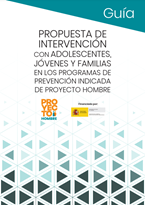
The ultimate goal of this guide is to provide the different prevention programs of the Proyecto Hombre Association with a common framework based on evidence.
We use cookies to give you the best experience.
Privacy policy